You don’t need to lift heavy weights or perform complicated movements to begin improving your strength.
If you’re over 60, returning to exercise after a long break, or simply more comfortable exercising with extra support, these seven movements offer a practical place to begin.
Start at your own pace, use a sturdy chair or stable support, and focus on controlled movements rather than speed.
Before you begin: if you have significant medical, mobility, balance or pain concerns, get guidance from an appropriate healthcare or qualified exercise professional before starting. Use a firm chair that does not roll, place it on a non-slip surface and keep the area clear. Move with control, breathe normally and stop if you feel pain or dizziness. Start with light weights or no weights.
Your First Chair & Supported Workout
New to exercise? Start with just 10–15 minutes.
Choose three or four exercises from the seven listed below. Begin with one comfortable set of approximately 8–10 repetitions per exercise, adjusting the number to your ability.
Rest whenever needed. Use a sturdy chair that won’t slide or tip, and avoid movements that cause pain or dizziness.
As you gain confidence, gradually work toward completing more of the exercises.
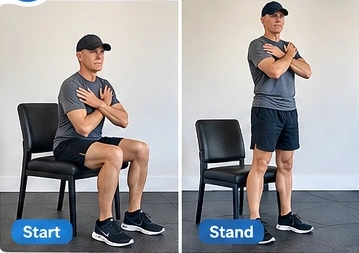
What it trains: Thighs, glutes and the strength used to rise from a chair.
Starting position: Sit near the front of a firm chair with both feet flat.
Finishing position: Stand tall with your feet flat and your body steady.
Sit near the front of a firm chair with both feet flat.
Lean forward slightly, press through your feet and stand tall.
Reach your hips back and lower to the chair with control.
Starting position (left) · Finishing position (right)
Beginner range: Begin with 1 set of 5–8 repetitions.
Modification / safety: Use a higher, stable chair or lightly push from the armrests if needed. Place the chair against a wall so it cannot slide.
2. Seated marching
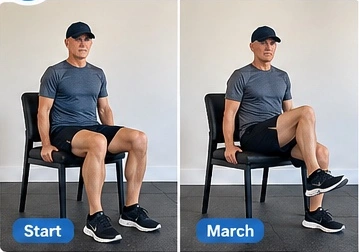
What it trains: Hip flexors, trunk control and coordination.
Starting position: Sit tall with both feet flat and hold the sides of the chair if helpful.
Finishing position: Lift one bent knee to a comfortable height while keeping your torso upright.
Sit tall with both feet flat and hold the sides of the chair if helpful.
Lift one knee only as high as feels comfortable.
Lower it gently, then alternate sides without rushing.
Starting position (left) · Finishing position (right)
Beginner range: Begin with 1 set of 6–10 lifts per side.
Modification / safety: Make the lift smaller if your back or hips feel strained. Keep both movements slow enough that you remain steady.
3. Seated knee extension
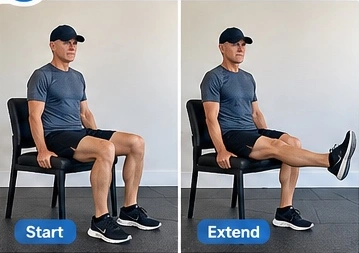
What it trains: The quadriceps at the front of the thigh.
Starting position: Sit back in a firm chair with your feet under your knees.
Finishing position: Extend one leg comfortably in front of you without forcing the knee to lock.
Sit back in a firm chair with your feet under your knees.
Slowly straighten one knee without forcing it to lock.
Pause briefly, lower with control and change legs.
Starting position (left) · Finishing position (right)
Beginner range: Begin with 1 set of 6–10 repetitions per leg.
Modification / safety: Use a comfortable, pain-free range. Skip ankle weights at first and stop if the movement causes knee pain.
4. Seated dumbbell curl
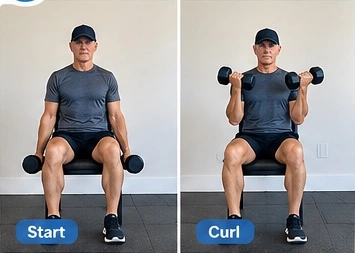
What it trains: Biceps and everyday pulling strength.
Starting position: Sit tall with a very light dumbbell in each hand and your arms by your sides.
Finishing position: Hold the weights toward your shoulders with your elbows close to your sides.
Sit tall with a very light dumbbell in each hand and your arms by your sides.
Keep your elbows close and curl the weights without swinging.
Lower slowly until your arms are comfortably straight.
Starting position (left) · Finishing position (right)
Beginner range: Begin with 1 set of 6–10 repetitions.
Modification / safety: Practise without weights first if needed. A palms-in hammer grip may feel more comfortable for the wrists or elbows.
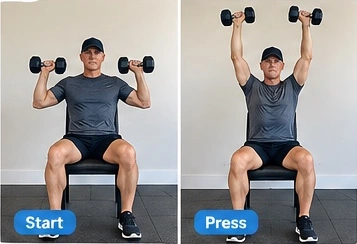
5. Seated shoulder press
What it trains: Shoulders, triceps and overhead strength.
Starting position: Sit against a supportive chair back with very light weights at shoulder level.
Finishing position: Hold your arms raised within a comfortable range, keeping your back supported.
Sit against a supportive chair back with very light weights at shoulder level.
Press upward only through a comfortable range.
Lower the weights slowly to the starting position.
Starting position (left) · Finishing position (right)
Beginner range: Begin with 1 set of 5–8 repetitions.
Modification / safety: Use one arm at a time or press with no weight. Do not force an overhead position if it causes shoulder or neck pain.
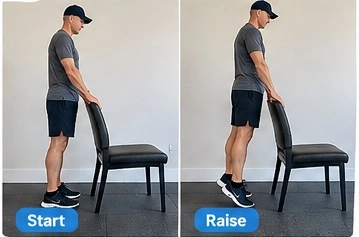
6. Supported calf raise
What it trains: Calves, ankle strength and standing stability.
Starting position: Stand behind a stable chair with your feet about hip-width apart.
Finishing position: Lift your heels while keeping both hands on the stable chair.
Stand behind a stable chair with your feet about hip-width apart.
Hold the chair lightly and rise onto the balls of your feet.
Pause, then lower your heels slowly.
Starting position (left) · Finishing position (right)
Beginner range: Begin with 1 set of 6–10 repetitions.
Modification / safety: Keep both hands on the chair if balance is uncertain. Use a small range and do not pull or tip the chair toward you.
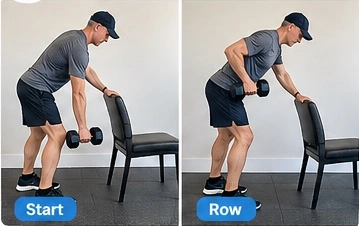
7. Supported row
What it trains: Upper back, rear shoulders and arms.
Starting position: Place one hand on a stable chair and hold a light dumbbell or band with the other.
Finishing position: Bring your elbow toward your hip with your torso steady and your supporting hand on the chair.
Place one hand on a stable chair and hold a light dumbbell or band with the other.
Brace your body and draw your elbow toward your hip.
Lower slowly without twisting your torso, then change sides.
Starting position (left) · Finishing position (right)
Beginner range: Begin with 1 set of 6–10 repetitions per side.
Modification / safety: Keep your back comfortable and use very light resistance. If leaning forward is uncomfortable, perform a seated band row instead.
The suggested ranges above are starting points. Rest between sets until you feel ready. When one set feels comfortable and you recover well, build gradually to two sets.
Comfort and control matter more than completing every exercise. Start with three or four movements, and add more only when the first session feels manageable and recovery is comfortable.
Ready to Build More Strength?
These chair and supported exercises can be a starting point for developing confidence and becoming more active.
When you’re comfortable with the movements and ready for a more structured routine, explore my free beginner strength-training programs.
I recommend starting with the two-day First Steps workout if you’re completely new to resistance training. There’s also a three-day program for those ready to train more often.